Marta Koch presented at MeasureDev 2026
Summary
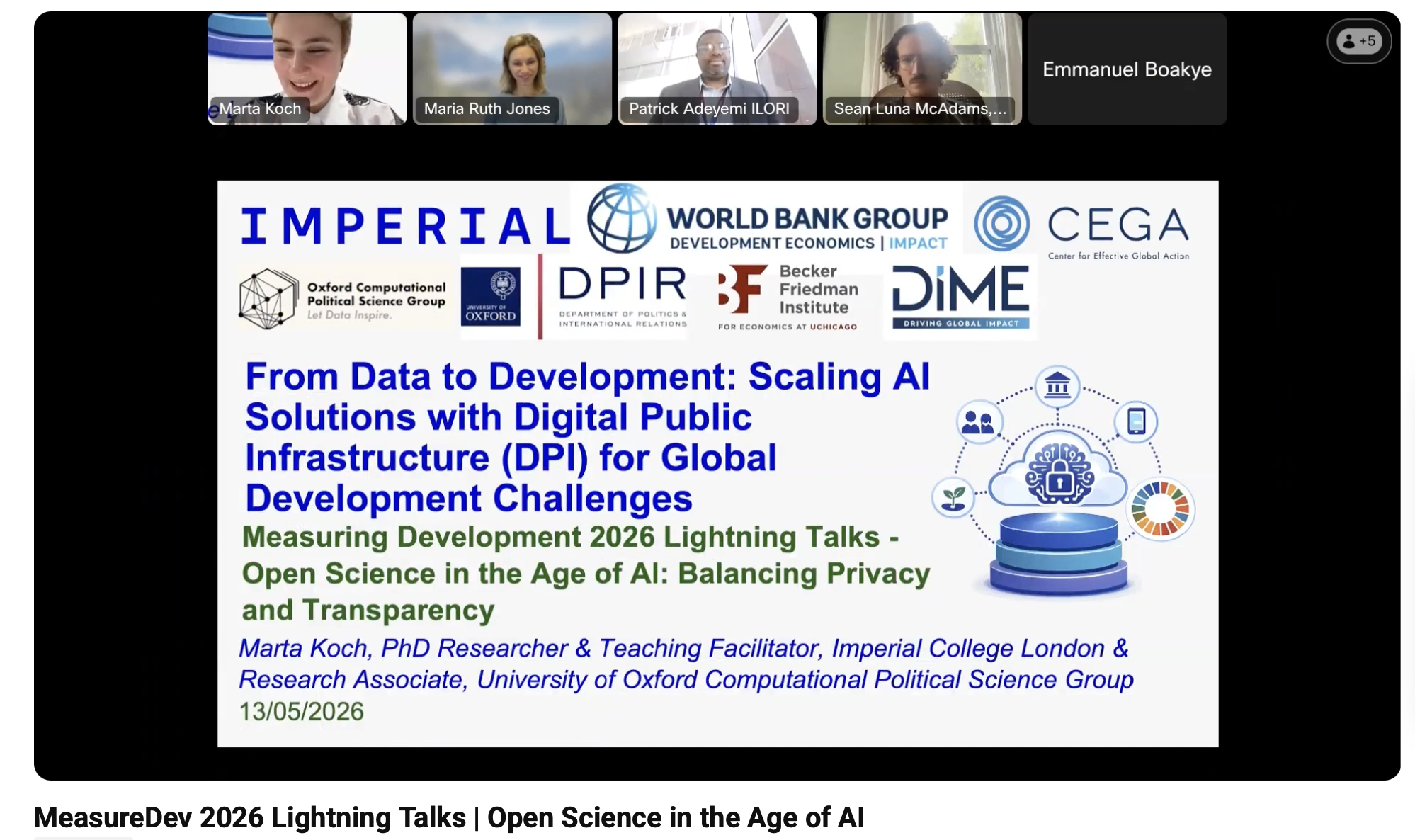
Marta Koch presented at the World Bank Group Measuring Development Conference 2026 (MeasureDev 2026) in the lightning talks event, Open Science in the Age of AI: Balancing Privacy & Transparency, on 13 May 2026.
The talk focused on the evolving global Digital Public Infrastructure (DPI) landscape and the growing role of AI in scaling development impact, measurement, and data ecosystems across public sector DPI domains. It explored how transparent, interoperable, and reproducible digital infrastructures, enhanced through responsible and sustainable AI scaling and tools, can support more inclusive public services, strengthen governance capacity, and improve sustainable development outcomes related to major global challenges such as climate action, health systems strengthening, and poverty reduction.
The presentation also connected these themes to Marta’s broader research on multilingual, inclusive, and reproducible open science frameworks and generative AI tools for policy agenda-setting and analysis, including her work as Technical Lead on multimodal models with the UNESCO Sciences Decade and her contributions to the OCPSG Benchmarking LLMs project.
The event brought together researchers and practitioners working at the intersection of AI, development research, and digital governance to discuss emerging tools and methodological approaches shaping the future of development measurement, data policy, and implementation.
Key highlight
A central highlight of the presentation was the discussion of how AI-enabled Digital Public Infrastructure systems can strengthen large-scale development data collection, interoperability, and evidence-sharing across national and international public sector institutions, language domains, and traditionally siloed institutions. The presentation emphasised the importance of combining scalable AI methods with transparent and reproducible digital data ecosystems to support more equitable and data-driven public sector decision-making across critical global policy challenges.
The main takeaway was that responsible and accurate AI systems, when integrated into interoperable DPI frameworks and reproducible research pipelines, have significant potential to enhance public sector innovation and improve development measurement and policy agenda-setting at scale. At the same time, the presentation emphasised the importance of balancing openness, reproducibility, and innovation with privacy protections, ethical governance, and responsible research principles when deploying AI-driven systems in policy development and implementation contexts.
More information
- Event details and the talk recording are available via World Bank Development Impact: YouTube recording
- UNESCO Sciences Decade